“Some hae meat and canna eat,
And some wad eat that want it;
But we hae meat, and we can eat,
And sae the Lord be thankit.”
— Robert Burns
Burns Night has a curious way of finding people, even those of us without a drop of Scottish blood. Held each year on the 25th of January, it marks the birthday of Robert Burns, poet, romantic, political firebrand, and chronicler of ordinary lives. What began as a small gathering of friends after his death has grown into a global tradition of food, poetry, whisky and ritual, repeated wherever people feel the pull of warmth and words in the heart of winter.
At its core, Burns Night isn’t really about haggis or tartan, though both play their part. It’s about gathering. About pausing in the dark stretch of the year to share a meal, raise a glass, and listen, properly listen, to poetry written in the language of everyday people. It’s a night that honours storytelling, hospitality and community, which perhaps explains why it travels so well beyond Scotland’s borders.
Our own Burns Night tradition began not with poetry, but with disappointment. One year, full of good intentions, we planned to go out for a Burns Supper at our local pub. We’d talked about it all week, the ceremony, the atmosphere, the excuse for whisky on a cold January evening. And then, at the last minute, we missed out. Fully booked. No haggis for us.
Rather than shrugging and moving on, we did what we often do when food plans fall apart: we decided to cook instead. If we couldn’t go to Burns Night, Burns Night would come to us. That first year was improvised and slightly chaotic, but something clicked. The structure of the evening, the sense of occasion, the way the food slowed us down — it felt like exactly what January needed.
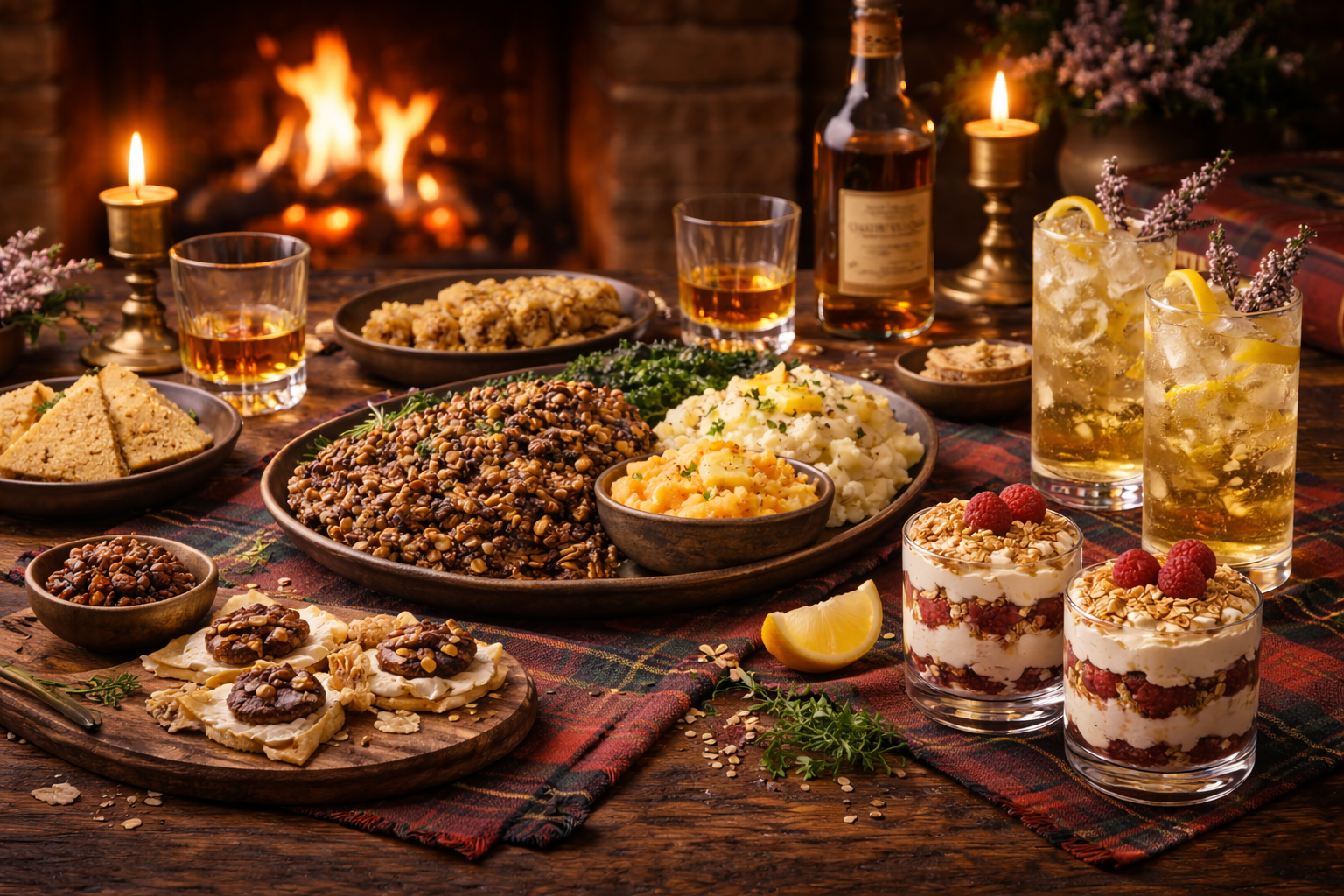
That was seven or eight years ago now, and we’ve done it every year since. Over time, the menu has evolved, especially as our cooking became fully vegan, but the spirit has stayed the same. There’s always a warming starter, always a centrepiece main, always whisky somewhere in the mix. And there’s always a moment, sometimes solemn, sometimes slightly giggly, where poetry is read aloud, and glasses are raised.
We’re not Scottish, and we’ve never pretended to be. What we love about Burns Night is that it doesn’t ask for authenticity in the narrow sense. It asks for sincerity. It asks you to show up, cook with care, and give the evening a little respect. In return, it gives you structure, warmth and permission to linger.
Each year, the night becomes less about reenacting tradition perfectly and more about making it our own. The food gets tweaked, the readings change, the cocktails improve. Some years are grander than others. Some years are just the two of us at the table, candles lit, the rain tapping against the windows.
We joke sometimes that we’re practising. That one day, we might actually end up in Scotland, and we’ll want to know what we’re doing. There’s a particular fantasy that returns each year around Burns Night, a house in the mountains, overlooking a loch, mist hanging low in the mornings and snow threatening but never quite arriving.
In this version of the dream, the kitchen is warm, the windows are wide, and Burns Night is no longer a special occasion but something quietly folded into the rhythm of life. Friends drop by, boots by the door, whisky poured without ceremony because the ceremony has become a habit.
Whether or not that ever happens doesn’t really matter. What matters is that once a year, in the deepest part of winter, we create a reason to pause. To cook food that takes time. To sit at the table and be present. To remember that traditions don’t have to be inherited to be meaningful, sometimes they just need to be chosen.
Burns Night found us by accident, but it stayed because it offered something we needed. And until that imagined lochside kitchen becomes reality, or remains a dream, we’ll keep practising, one January evening at a time.