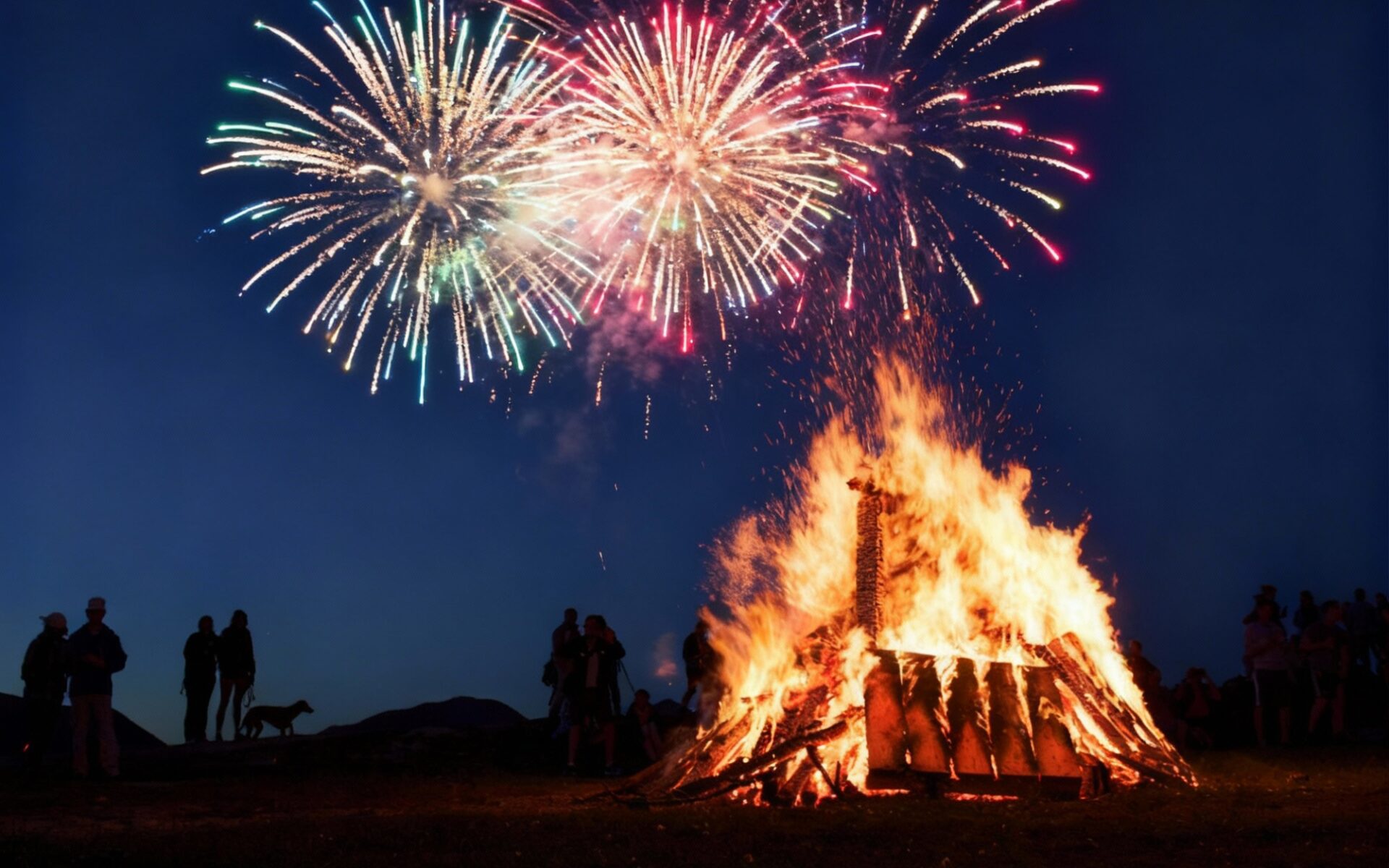
“Remember, remember, the fifth of November…”
There was always something spellbinding about Bonfire Night when I was a child. The chill in the air carried that unmistakable scent of woodsmoke, damp leaves, and anticipation. Wrapped up in scarves and mittens, we’d follow the glow of the fire from down the street, the night alive with chatter and the occasional crackle of a distant firework. There, in the heart of the field, stood the towering bonfire, its orange flames licking at the dark November sky like a living thing.
I remember standing close enough to feel the heat on my face, but far enough to keep my toes from getting singed. In one hand, a sparkler hissed and fizzed, tracing loops of light in the cold air; in the other, a toffee apple gleamed, sticky and perfect. It was impossible to decide which I loved more, the sparkle or the sweetness, both felt like magic. The world seemed to pause for a moment in that golden glow, as if the fire itself was holding back the winter for just one more night.
The fireworks came next, shrieking, dazzling, bursting across the sky in a chaos of colour. We’d all tilt our heads back at once, our breaths visible in the cold, gasping in unison at each new explosion. The bangs would echo through our chests, the air thick with smoke and laughter. Somewhere, someone would hand out paper cups of hot chocolate, and we’d clutch them tightly, grateful for the warmth that seeped through the cardboard and into our fingers.
Those nights always felt endless, as childhood nights often do. Walking home afterwards, my clothes would smell faintly of smoke, my boots caked with mud, and my cheeks flushed pink from the cold. Even now, that scent, of firewood and sugar, can pull me back to those moments in an instant. Bonfire Night wasn’t just about fireworks or flames; it was about belonging. About being huddled together in the dark, sharing warmth and wonder under the same crackling sky.
Of course, at that age, I didn’t know the darker story behind it all. The name “Guy Fawkes” meant little more than a figure made of old clothes stuffed with newspaper, paraded around on a wheelbarrow before being tossed onto the fire. It was years before I learned the truth, that Bonfire Night began in 1605, when Fawkes and his fellow conspirators plotted to blow up the Houses of Parliament. Their failed attempt was commemorated with bonfires across the country, a public celebration of survival and loyalty to the Crown.
Over the centuries, what began as a political ritual turned into something far gentler, far more communal. The “Penny for the Guy” chants faded, the effigies became less common, and the fireworks grew brighter. Bonfire Night became a celebration not of vengeance, but of togetherness, of gathering against the cold, lighting the darkness, and marking the slow slide into winter with something spectacular.
By the time I was a teenager, the local field bonfires had given way to organised displays and safety barriers, but the magic never quite disappeared. There was still that same collective gasp as the first rocket soared skyward. The same smell of smoke and damp grass. The same sticky sweetness of toffee and caramel clinging to the air. It was a night that connected generations, grandparents recalling the bonfires of their youth, parents handing sparklers to their children, everyone craning their necks to watch the sky bloom with light.
Now, as an adult, the tradition has changed shape again. The field has become our garden; the roaring bonfire, a small firepit. Instead of plastic cups of cocoa, there’s mulled wine gently simmering on the stove, perfuming the kitchen with cinnamon and cloves. And rather than a crowd of neighbours, it’s usually just the two of us, standing arm in arm, sipping something warm, watching the night flicker beyond the glass.
There’s something quietly romantic about it now. The chaos of the fireworks feels less about noise and more about nostalgia, a celebration of memory itself. I can see my younger self in the sparkle of the flames: mittened hands, sticky cheeks, and wide-eyed awe. My husband and I sometimes light a sparkler for old times’ sake, laughing as it splutters and dances in the dark, tracing invisible words that vanish as quickly as they appear.
Bonfire Night still has that same strange blend of excitement and comfort. It’s a reminder that even as the days grow short and the air turns cold, there’s beauty in the glow, in gathering together, in warmth shared, in old traditions that keep finding new life. The fire may be smaller now, the crowd thinner, but the feeling remains unchanged: the joy of light against darkness, of sweetness against smoke.
It’s that feeling, the blend of nostalgia and warmth, history and heart, that inspired this menu. Not in its flavours alone, but in its spirit: a celebration of British tradition, of memory, and of the simple pleasure of standing by the fire with someone you love. Every dish is an echo of those nights, glowing, comforting, and touched with smoke, but the story began long before the first recipe. It began with a sparkler in one hand, a toffee apple in the other, and a sky full of light.